
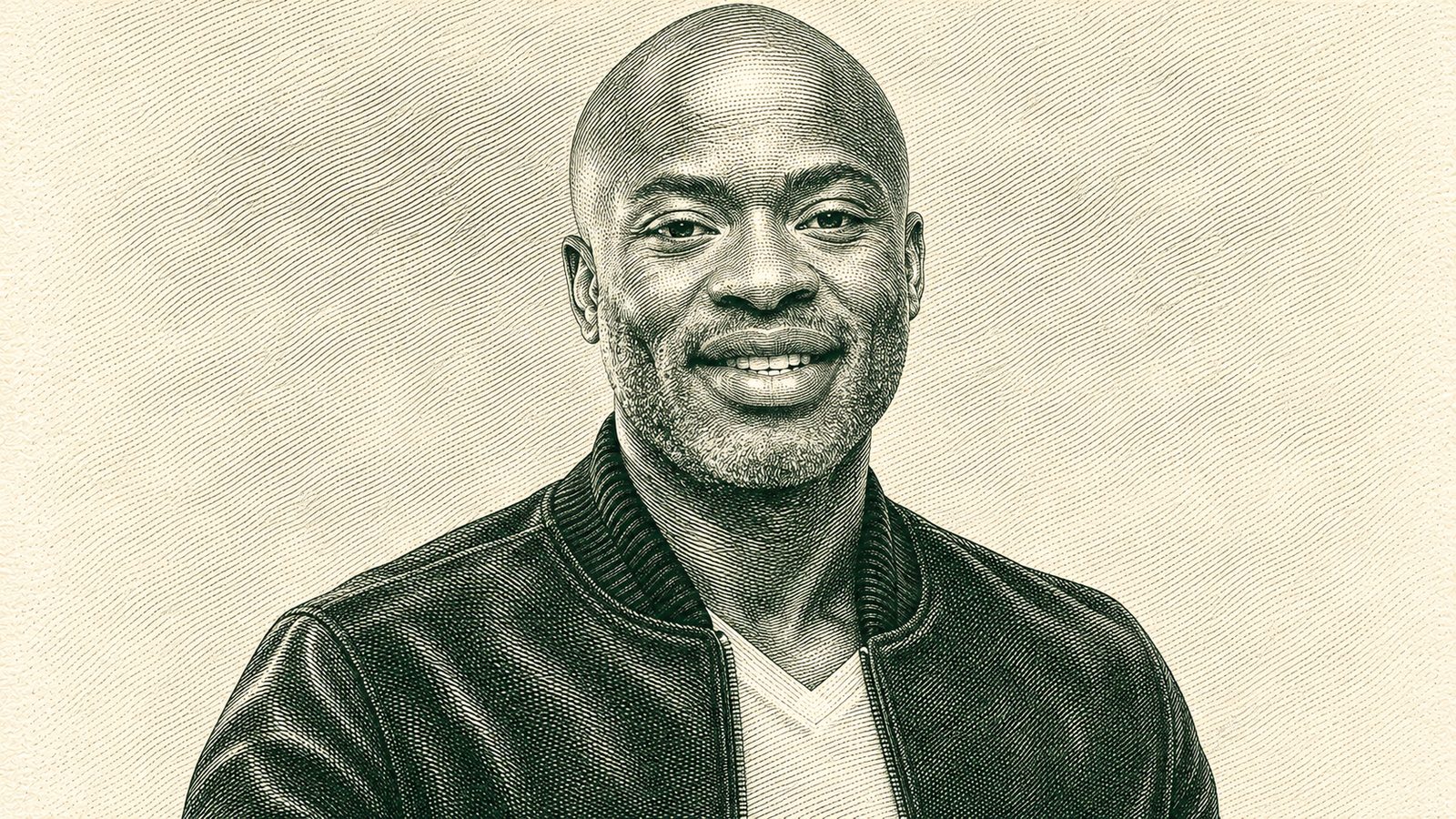

If you have booked a meeting in the last ten years, there is a good chance a Nigerian boy from Lagos set it up for you.
You clicked a link. You picked a time. No back and forth. That link was Calendly, and the man who built it is Tope Awotona.
He did not build it in Silicon Valley. He built it in Atlanta. He did not build it with venture money first. He built it with his own savings, his 401(k) and his credit cards. And he did not get there on his first try. Or his second. Or his third.
This is Part 2 of Immigration Stories, where we look at one immigrant who built something extraordinary in America and ask what the founder reading this can actually take from their path. Part 1 was Jensen Huang. This one is personal for me, because Tope's story starts in the same city mine does.
The night that changed everything
Tope Awotona was born in Lagos into a middle-class family. His father was a microbiologist who left his job to start his own company. His mother worked at the Central Bank of Nigeria.
When Tope was 12, his father was shot and killed in a carjacking. Tope saw it happen.
Anyone who grew up in Lagos in the 1990s knows that this was not a freak event. It was the fear every family carried. For the Awotonas, the fear became real.
Years later, Tope told Inc. that part of him, from a very early age, wanted to redeem his father. His dad never got to finish building what he started. Tope decided he would.
That is not a business plan. That is a reason. And reasons outlast plans.
Atlanta, 1996
In 1996, at 15, Tope moved with his family to Atlanta, Georgia.
He has described Atlanta as a big city like Lagos, with crazy traffic, and said that is where the similarities ended. Lagos, as he put it, had an absence of law, order and structure. Atlanta had all three.
He went on to the University of Georgia, started in computer science, and moved into business and management information systems.
Then he did what a lot of immigrants do. He got a job and he got good at it.
The salesman
Tope spent years in enterprise sales. IBM. Perceptive Software. Vertafore. EMC, which Dell later acquired.
Sales is an underrated school for founders. You learn how to hear no. You learn what customers actually pay for. And if you sell software for long enough, you spend a ridiculous amount of your life doing one thing: emailing people back and forth to find a time to meet.
Remember that. It matters later.
Three strikes
While he was working, Tope kept trying to start businesses on the side.
First, a dating website. It never really got off the ground.
Second, an e-commerce site selling projectors. The margins were thin, supply was inconsistent, and by his own admission he knew nothing about projectors.
Third, a site selling grills and garden equipment. Same story.
Three businesses. Three failures.
Here is the lesson he took from it, and it is the one most people miss. He said those businesses failed because he was chasing money, not solving a problem he cared about. He didn't care about projectors. He didn't care about grills. So when things got hard, there was nothing holding him there.
So he took a break from starting businesses. And then the problem found him.
The problem he actually cared about
Tope was trying to schedule a meeting. The email chain went back and forth, again and again, the way it always did in his sales job. He looked at the scheduling tools that existed and didn't like any of them.
This time the pain was his. He had lived it for years.
In 2013, he started Calendly at Atlanta Tech Village, a coworking space for entrepreneurs. Then he made the decision that defines his story.
He went all in. About $200,000. His life savings, his 401(k), maxed out credit cards. He later quit his job at EMC to focus on it.
He explained it simply. With his earlier businesses, he had hedged and given himself a way out. With Calendly, he put in every cent. His words: "If you're going to do something, you have to go all in."
I'm not telling you to drain your retirement account. I am telling you to notice the pattern. The three businesses where he kept an exit door open all failed. The one where he burned the boats is the one that worked.
Growth without the hype
Calendly grew the way the best products grow. People used it, and every time they sent a Calendly link, the person on the other end saw it and wanted one too.
In 2014, Atlanta Ventures led a $550,000 seed round. That was it for outside money for years. Tope ran the business lean while Silicon Valley startups were burning through hundreds of millions.
Then in January 2021, after seven years of mostly quiet growth, Calendly raised $350 million from OpenView and ICONIQ at a $3 billion valuation. Not bad for a company that, before that round, had taken in just $550,000 plus the founder's life savings.
Forbes later named him one of the wealthiest immigrants in America and counted him as a billionaire, one of only two Black tech billionaires in the U.S. at the time. The other was David Steward of World Wide Technology.
Today Calendly says it has more than 20 million users in over 230 countries. In 2025, Carnegie Corporation of New York named him one of its Great Immigrants.
And he is still the CEO. Thirteen years in.
What you can take from Tope's path
First, the honest part. Tope came to America at 15 with his family. The details of his immigration status over the years are not public. His door does not look like yours.
If you are a founder, researcher or operator today, your door probably looks like an O-1A, an EB-1A or an EB-2 NIW. Different paperwork. Same principle. Here is what I take from his story:
1. Your pain can become your purpose. Tope lost his father in the worst way imaginable and turned it into a reason to build. Many of us came from hard places. Don't hide that chapter. It is often the engine.
2. Your day job is research. Seven years of sales gave him the exact problem Calendly solves. Whatever job you are doing right now, pay attention to what frustrates you and the people around you. Your next company might be hiding in your calendar.
3. Failure is tuition, if you learn the lesson. Three failed businesses taught him to stop chasing money and start solving problems he cared about. Write down what each failure taught you. Those lessons compound.
4. Go all in, but on the right thing. He didn't go all in on projectors. He went all in once he had a problem he lived every day. Conviction is only smart when it sits on real pain and real evidence.
5. You don't need to be in Silicon Valley. He built a $3 billion company from Atlanta, which is part of why I believe so much in what's happening here in the DMV. Great companies get built where great founders are.
6. Keep your receipts. The seed round, the user numbers, the press, the honors. Every one of those is evidence. If you are building a case for an O-1A or EB-1A, that evidence is the case. Start collecting your BRAGGABLES the day they happen, not the week before your petition is due. (Here are the most common reasons O-1 petitions get denied.)
7. Immigration is a wealth-building strategy. A widow moved her family from Lagos to Atlanta. One of her sons built a product used by tens of millions of people in over 230 countries, hired hundreds of people, and created billions of dollars in value. That is what America gets when it lets the world's most driven people in.
We say it back home: a moving man will meet his luck. Tope kept moving through three failures. On the fourth try, he met it.
Keep moving.
Next in Immigration Stories: tell me who you want me to write about.
Agora is an immigration technology firm, not a law firm, and is not affiliated with USCIS or the Department of State. Legal services are provided by independent licensed attorneys in the Agora network.
Sources
- Tope Awotona, Great Immigrants 2025, Carnegie Corporation of New York
- Nigeria-Born Tope Awotona Poured His Life Savings Into Calendly, Forbes (via Kola King)
- Calendly raises $350M at a $3B valuation, TechCrunch
- How Tope Awotona took a wild risk with Calendly, Nairametrics
- SaaS Product Validation: 3 Failed Startups to Calendly, The SaaS Podcast
- Tope Awotona, People of Color in Tech