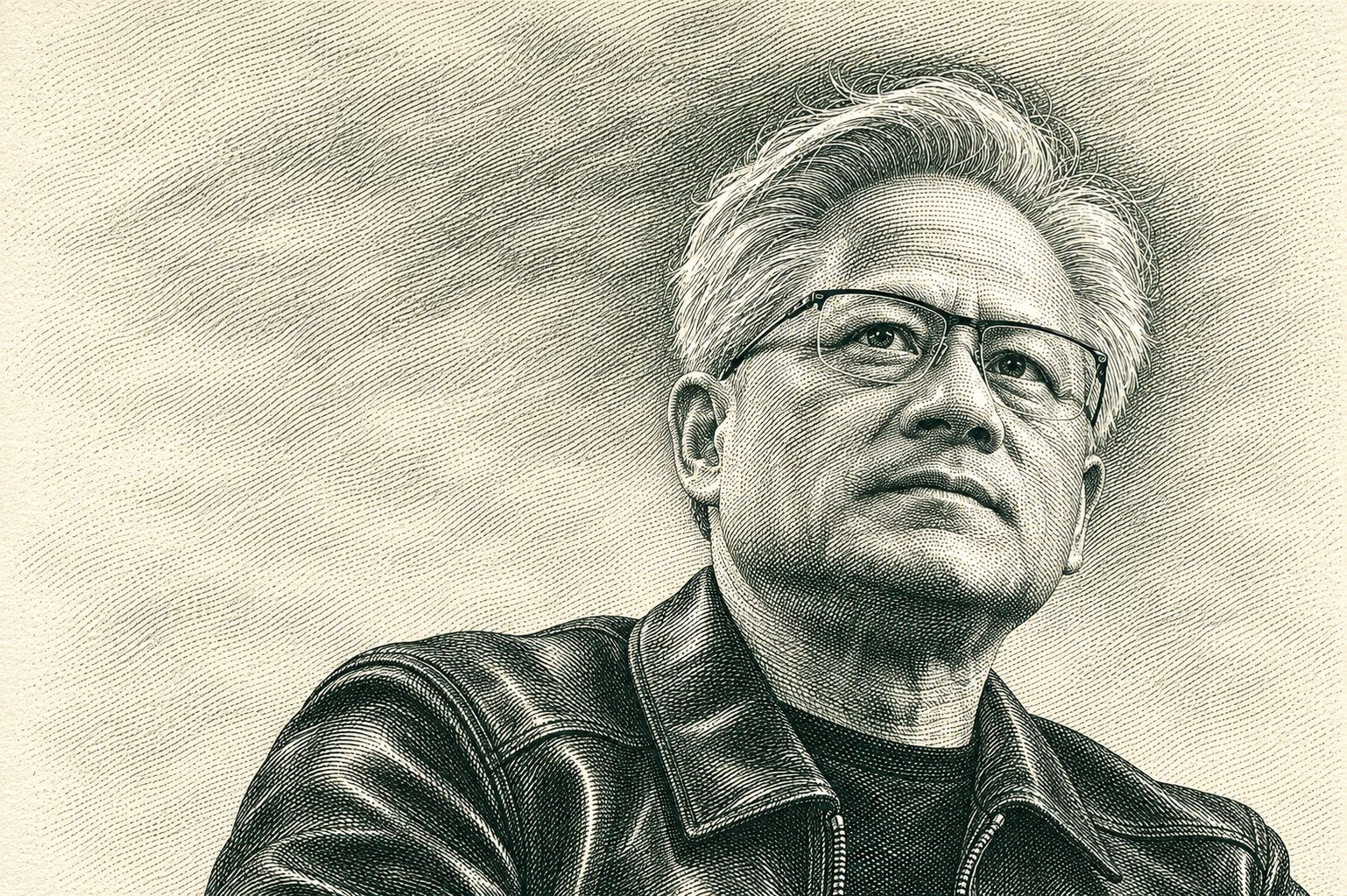

In 1973, a nine-year-old boy who barely spoke English landed in Tacoma, Washington, with his older brother. No parents. Just an uncle he had never met and a promise that America would be better than what they were leaving behind.
The uncle did his best. He found a boarding school in Kentucky and enrolled both boys. He thought it was a prestigious academy.
It was a reform school for troubled kids.
That boy was Jensen Huang. Today he runs Nvidia, the company that powers almost every serious AI system on earth. And the first job America gave him was cleaning toilets.
This is the first piece in a new series I'm calling Immigration Stories. Every edition, we look at one immigrant who built something extraordinary in America, and we ask a simple question: what can the founder reading this from Lagos, Bangalore, São Paulo or Cairo actually take from their path?
Let's start with the most valuable founder story of our generation.
The wrong school
Jensen Huang was born in Tainan, Taiwan, in February 1963. When he was five, his family moved to Thailand for his father's work. A few years later, Thailand was in political turmoil, and his parents made the kind of decision only immigrant parents understand. They sent their two sons ahead to America, alone.
To pay the tuition, his parents sold nearly everything they owned.
The school was the Oneida Baptist Institute in Clay County, Kentucky, one of the poorest counties in the country. Jensen was too young for the academy's classes, so he lived in the dormitory and walked to the local public elementary school. He was small, Asian, long-haired and heavily accented in rural 1970s Kentucky. You can imagine how that went. He was bullied. He was beaten.
Every student had to work. His brother was sent to a tobacco farm. Jensen got the toilets. Every day.
His roommate was a 17-year-old who couldn't read. So they made a deal: Jensen taught him to read, and he taught Jensen to bench press.
Here is the part that gets me. Decades later, Jensen and his wife Lori gave $2 million to that same school to build a new dormitory and classroom building for girls. It opened in 2019. He has said he loved his time there.
Most people would spend their lives resenting that place. He went back and built a hall.
Denny's, the graveyard shift
About two years after the boys arrived in Kentucky, their parents finally made it to the United States and settled in Beaverton, Oregon. The family was together again.
Jensen went to Aloha High School. He skipped two grades and graduated at 16. He joined the math, computer and science clubs. At 15 he placed third in junior doubles at the U.S. Open table tennis championships.
And he worked. From 1978 to 1983 he was a dishwasher, then a busboy, then a waiter at a local Denny's, often on the graveyard shift.
Go look at his LinkedIn today. The man runs a company worth over four trillion dollars, and he lists exactly two jobs: Founder and CEO of Nvidia, and dishwasher, busboy and waiter at Denny's.
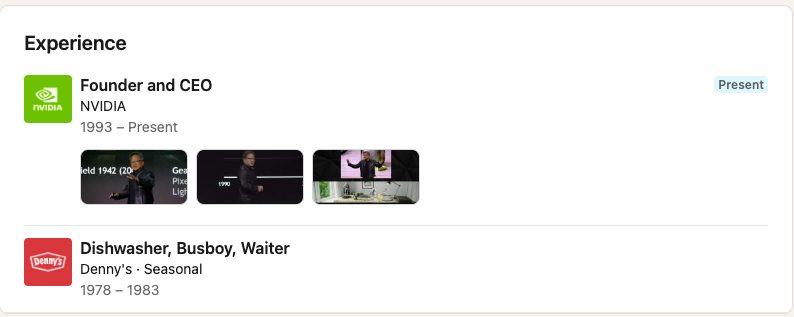 Image source: Magnific
That is not humility for the cameras. That is a man who knows exactly where his foundation was poured.
The engineer
For college, he picked Oregon State University for one reason: in-state tuition was cheap. He studied electrical engineering and graduated in 1984 with highest honors.
His class had about 250 students. Three were women. One of them, Lori Mills, was his lab partner. She became his wife.
He went to work designing chips, first at AMD, then at LSI Logic, and earned his master's in electrical engineering from Stanford in 1992. At LSI, he was assigned to work with two engineers at Sun Microsystems, Chris Malachowsky and Curtis Priem.
The three of them started asking a dangerous question: why are we building this for someone else?
The booth
In 1993, the three engineers started meeting at a Denny's at the corner of Capitol and Berryessa in East San Jose. Jensen picked it. He knew Denny's. The coffee was cheap and it was quieter than home.
In that booth they decided to build a company making 3D graphics chips for video games. They pooled about $40,000. Jensen was 30 years old.
That booth now has a plaque on it.
Thirty days from dying
Nvidia nearly died young. Its first product, the NV1, flopped. A deal to build a graphics chip for Sega's next console went wrong because Nvidia had bet on the wrong technical approach. The company was close to bankruptcy.
Jensen did the hardest thing a founder can do. He went to the customer, admitted the approach was wrong, and negotiated his way out of the contract in a way that left Nvidia with enough money to survive and build its next chip.
For years afterwards, Jensen reportedly opened company presentations with the same line: our company is thirty days from going out of business.
If you are an immigrant founder, you know that feeling in your bones. Thirty days from the visa expiring. Thirty days from rent. Thirty days from going home with nothing to show. Jensen turned that fear into an operating system.
The bet nobody wanted
In 1999, Nvidia launched the GeForce 256 and called it the world's first GPU. In 2006 it launched CUDA, which let scientists and engineers use graphics chips for general computing. For years, Wall Street did not care. It cost money and gamers didn't need it.
Then the AI researchers showed up. They discovered that GPUs were perfect for training neural networks. When ChatGPT arrived in late 2022 and the whole world suddenly needed AI chips, Nvidia had a ten-year head start.
In October 2025, Nvidia became the first company in history to pass a $5 trillion market value. Jensen's own stake is worth roughly $150 billion, depending on the day.
From the toilets of Oneida to the most valuable company on the planet. In one lifetime.
He has not forgotten the door
In September 2025, the U.S. government introduced a $100,000 fee on new H-1B visa petitions. Plenty of companies went quiet.
Jensen sent his staff a memo. Nvidia would keep sponsoring H-1B visas and would cover every associated cost, including the new fee. He told employees the company's success "would not be possible without immigration." Nvidia sponsors around 1,400 visas.
He also said his own family's journey to America would not have been possible under those rules. A federal court vacated the fee in June 2026, but the point stands.
Sit with that. The most important technology company of this era was built by a boy whose path in might not exist today.
What you can take from Jensen's path
Let me be clear about one thing first. Jensen came to America as a child, in 1973, through family. The details of his exact immigration status over the years are not public. His door does not look like yours.
If you are a founder, researcher or operator today, your door probably looks like an O-1A, an EB-1A or an EB-2 NIW. Different paperwork. Same principle. Here is what I take from his story:
1. You will not always pick the school. His uncle sent him to the wrong one. You will land in the wrong job, the wrong city, the wrong visa category, the wrong first year. Jensen didn't waste energy on the door he got. He focused on what he did once he was inside it.
2. No job is beneath your story. Dishwasher. Busboy. Toilets. He still lists Denny's on his profile. The humble chapters are not something to hide. They are the proof of grit that every strong petition and every strong pitch is built on.
3. Keep your receipts. Nobody wrote "future trillion-dollar founder" on Jensen's report card. Your achievements only count if you can prove them. Save the press mention, the award letter, the judging invitation, the revenue screenshot the day it happens. I call these BRAGGABLES. Future you, and future your immigration case, will thank you. (If you're weighing an EB-1A, read the 10 most common EB-1A mistakes first.)
4. Live thirty days from dying, but keep shipping. Fear is not the enemy. Paralysis is. Jensen used the fear as fuel and kept building through the near-death years.
5. Make the long bet. CUDA looked like a waste of money for almost a decade. The work you do now, that nobody is clapping for yet, could be your CUDA.
6. Immigration is a wealth-building strategy. Not just for the immigrant. For the country. One family's decision to send two boys across the ocean helped produce a company that now anchors the American AI economy. That is the deal America has always offered the world's most driven people. Those of us who take it should make it count.
We have a saying back home: a moving man will meet his luck. Jensen Huang has been moving since he was nine.
Keep moving.
Next in Immigration Stories: tell me who you want me to write about.
Agora is an immigration technology firm, not a law firm, and is not affiliated with USCIS or the Department of State. Legal services are provided by independent licensed attorneys in the Agora network.
Sources
- Jensen Huang, Wikipedia
- Jensen Huang, Britannica
- Before running the world's most valuable company, Jensen Huang was a 9-year-old janitor in Kentucky, Fortune via AOL
- Jensen Huang on engineering and the AI era, Fortune (April 2026)
- The founding of Nvidia in the founders' words, Sequoia Capital
- Nvidia will keep sponsoring H-1B visas and pay the $100K fee, Fortune (Oct 2025)
- Huang says the H-1B fee would have barred his family, Storyboard18