
In October 1980, a 17-year-old from Lagos landed at JFK to visit St. John's. Nobody came to meet him. It was cold, colder than anything he had ever felt, and New York was moving too fast.
The story Houston loves to tell is that he asked an airport worker which of his schools had weather most like Nigeria, and got back on a plane. Hakeem tells it a little differently: his mentor, Christopher Pond, had already told him Houston was where he belonged. Either way, he arrived early, and nobody from the university was waiting for him there either. The coach, Guy Lewis, still wasn't sure about this kid. He told him to take a taxi.
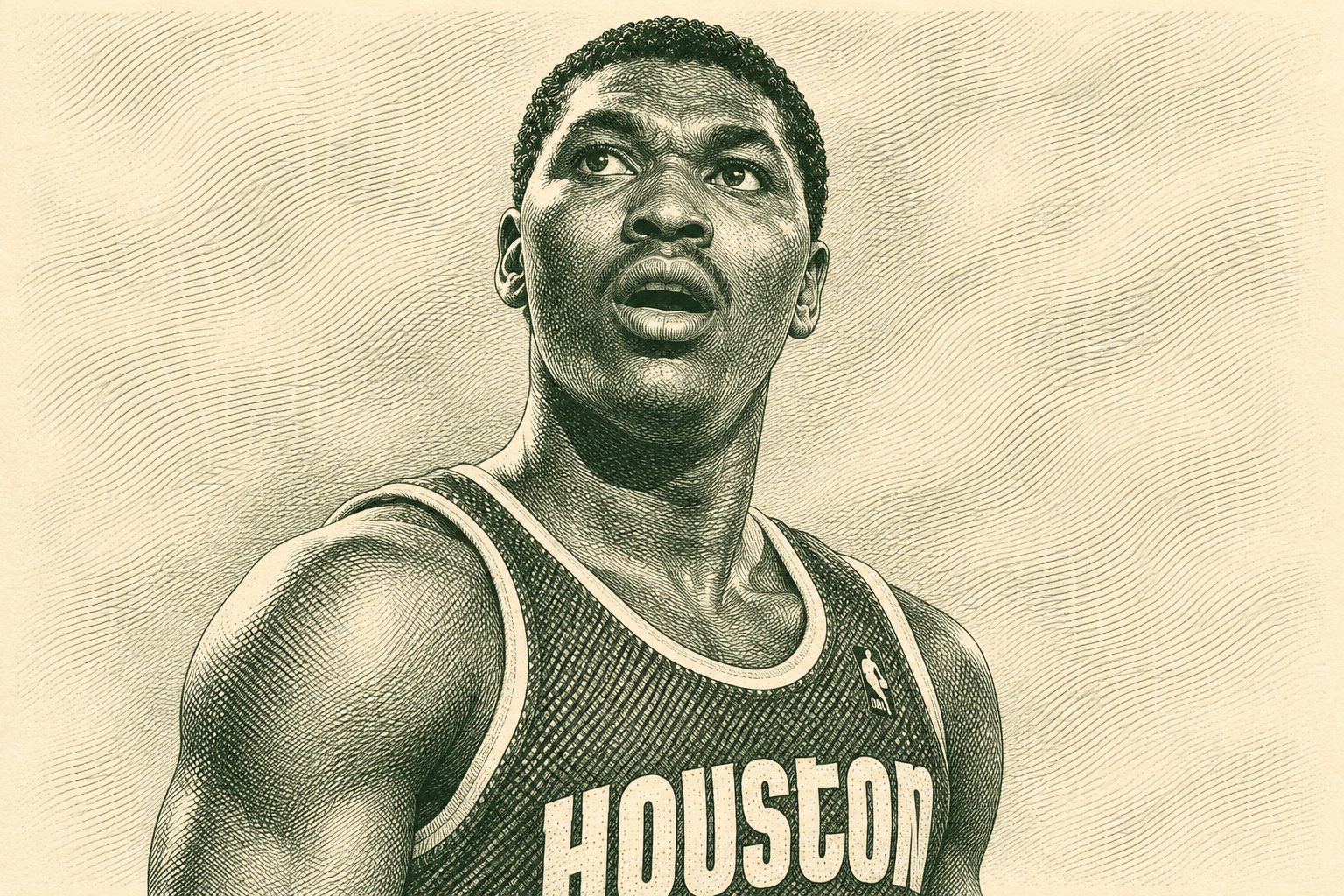
So a seven-footer unfolded himself out of a Houston cab. Lewis handed him a brand-new pair of size 14 sneakers. You couldn't find those in Nigeria.
Here is the part that should stop you: he had only been playing basketball for about two years. When he got to Houston, he could barely dribble.
Fourteen years later, he was the best basketball player on the planet.
This is Part 4 of Immigration Stories, where we look at one immigrant who built something extraordinary in America and ask what the founder reading this can actually take from their path. Part 1 was Jensen Huang. Part 2 was Tope Awotona. Part 3 was Sergey Brin. This one is another Lagos boy, and he did it twice: once on the court, and once in business.
The goalkeeper
Hakeem Olajuwon was born in Lagos on January 21, 1963. His parents, Salam and Abike, ran a cement business. In Yoruba, Olajuwon roughly means "always being on top."
He grew up playing soccer as a goalkeeper and team handball at Muslim Teachers College in Lagos. Basketball was not on his radar.
Then, at 15, a coach put a basketball in his hands for a local tournament. He made his first basket and, by his own account, fell in love with the game on the spot and dropped every other sport.
Remember the goalkeeping. It matters later.
Six schools, one taxi
Within two years he was one of the best young players in Nigeria. A coach named Christopher Pond called his contacts in America and arranged for Hakeem to visit six schools, including St. John's and the University of Houston.
He came to Houston in the fall of 1980 under coach Guy Lewis. The NCAA had not cleared him to play yet, so he sat out his first year. When he did play, he came off the bench.
He was raw. He was learning the game in public, in a new country, in a new language, at the highest level of college sports.
He kept working. By his third season he was the center of one of the most famous college teams ever, the high-flying Houston Cougars known as Phi Slama Jama, alongside Clyde Drexler. Houston made three straight Final Fours.
The number one pick
In the 1984 NBA Draft, the Houston Rockets took Akeem Olajuwon first overall. The third pick that year was a guard from North Carolina named Michael Jordan.
He spent 17 seasons in Houston. He became the Rockets.
And remember the goalkeeping? His signature move, the "Dream Shake," came straight from it. Footwork, fakes, spins. A seven-footer who moved like a goalkeeper reading a penalty kick. Nobody could guard it.
The greatest season
In 1991, he changed the spelling of his first name from Akeem to Hakeem, to reflect the proper Arabic spelling.
On April 2, 1993, he was sworn in as a United States citizen.
The next season, 1993-94, he did something no player in NBA history had done before or has done since. He won league MVP, Defensive Player of the Year and Finals MVP in the same season. The Rockets won the championship. In 1995 they won it again, and he was Finals MVP again.
In 1996, the boy from Lagos won an Olympic gold medal playing for the United States in Atlanta. He had missed the original 1992 Dream Team because he was not yet a citizen.
He retired in 2002 as the NBA's all-time leader in blocked shots, with 3,830. In 2008 he was inducted into the Basketball Hall of Fame.
The second career
Most athletes' stories end there. Many end worse: big contracts, bad advice, broke within a few years.
Hakeem's didn't. He earned more than $100 million in salary over his career. While he was still playing, he started buying real estate in Houston, the city he knew better than any investor from out of town. He called it a home court advantage.
And he did it differently. As a devout Muslim, he would not pay or collect interest. So no mortgages, no leverage. He bought with cash.
By 2006, four years after retiring, the New York Times reported he had already done more than $100 million worth of Houston real estate deals. His reason was simple: "I like real estate because, you know, it's real."
Estimates of his net worth today run around $300 million. Those are estimates, not audited numbers. But the point stands. He turned a playing career into lasting wealth, without borrowing a dollar.
What you can take from Hakeem's path
First, the honest part. Hakeem came to America as a student athlete in 1980 and became a citizen in 1993. The details of every visa he held along the way are not public. His door does not look exactly like yours.
But his story is closer to today's paths than most people realize. Elite athletes, coaches and sports professionals are exactly who the O-1A and EB-1A categories were built for. "Extraordinary ability in athletics" is written right into the law. The same goes for founders, researchers and operators, who often use the O-1A, EB-1A or EB-2 NIW. Different paperwork. Same principle. Here is what I take from his story:
1. It's never too late to start. He picked up a basketball at 15. Most NBA stars had been playing for a decade by then. You may be switching careers at 30 or 40, or starting a company in a new country. Late is not the same as too late.
2. Your old skills are your edge. The goalkeeping became the Dream Shake. Whatever you did before, the industry you left, the country you came from, the language you speak, that is not baggage. It is the move nobody else has.
3. Be raw in public. He couldn't dribble when he arrived and he sat on the bench while he learned. Immigrants rarely get to arrive polished. Get comfortable being a beginner where people can see you.
4. Use your home court advantage. He invested where he knew the ground. Start with the market, community and network you understand better than anyone else.
5. Build wealth on terms you can live with. He refused debt and still built a fortune. Your values can shape your strategy instead of limiting it.
6. Keep your receipts. Draft position, awards, championships, records, press. For an athlete or a founder chasing an O-1A or EB-1A, that is the evidence. Start collecting your BRAGGABLES the day they happen.
7. Immigration is a wealth-building strategy. A Lagos goalkeeper took a taxi to a Houston campus. He brought two championships to the city, wore the American flag at the Olympics, and then put his earnings back into Houston real estate. That is the full cycle, and Houston got all of it.
We say it back home: a moving man will meet his luck. Hakeem got on a plane at 17 with two years of basketball behind him. He met his luck in the back seat of a Houston taxi.
Keep moving.
Next in Immigration Stories: tell me who you want me to write about.
Agora is an immigration technology firm, not a law firm, and is not affiliated with USCIS or the Department of State. Legal services are provided by independent licensed attorneys in the Agora network.
Sources
- Olajuwon, Hakeem Abdul, Encyclopedia.com
- Hakeem Olajuwon, NBA.com Legends
- Hakeem Olajuwon, Britannica
- Hakeem Olajuwon, EBSCO Research Starters
- Hakeem Olajuwon interview with Charlie Rose (transcript)
- Dream's Team: Olajuwon steps into the role of model citizen, Sports Illustrated
- Hakeem Olajuwon, Olympedia
- 60 things to know about Hakeem Olajuwon, KPRC 2
- Hakeem Olajuwon's real estate career, Celebrity Net Worth
- Phi Slama Jama, Houston History Magazine
- Nigeria, Olajuwon and the city: a match made in hoops heaven, FIBA
- Outtakes from our Hakeem Olajuwon interview, Houstonia